Financing Law School
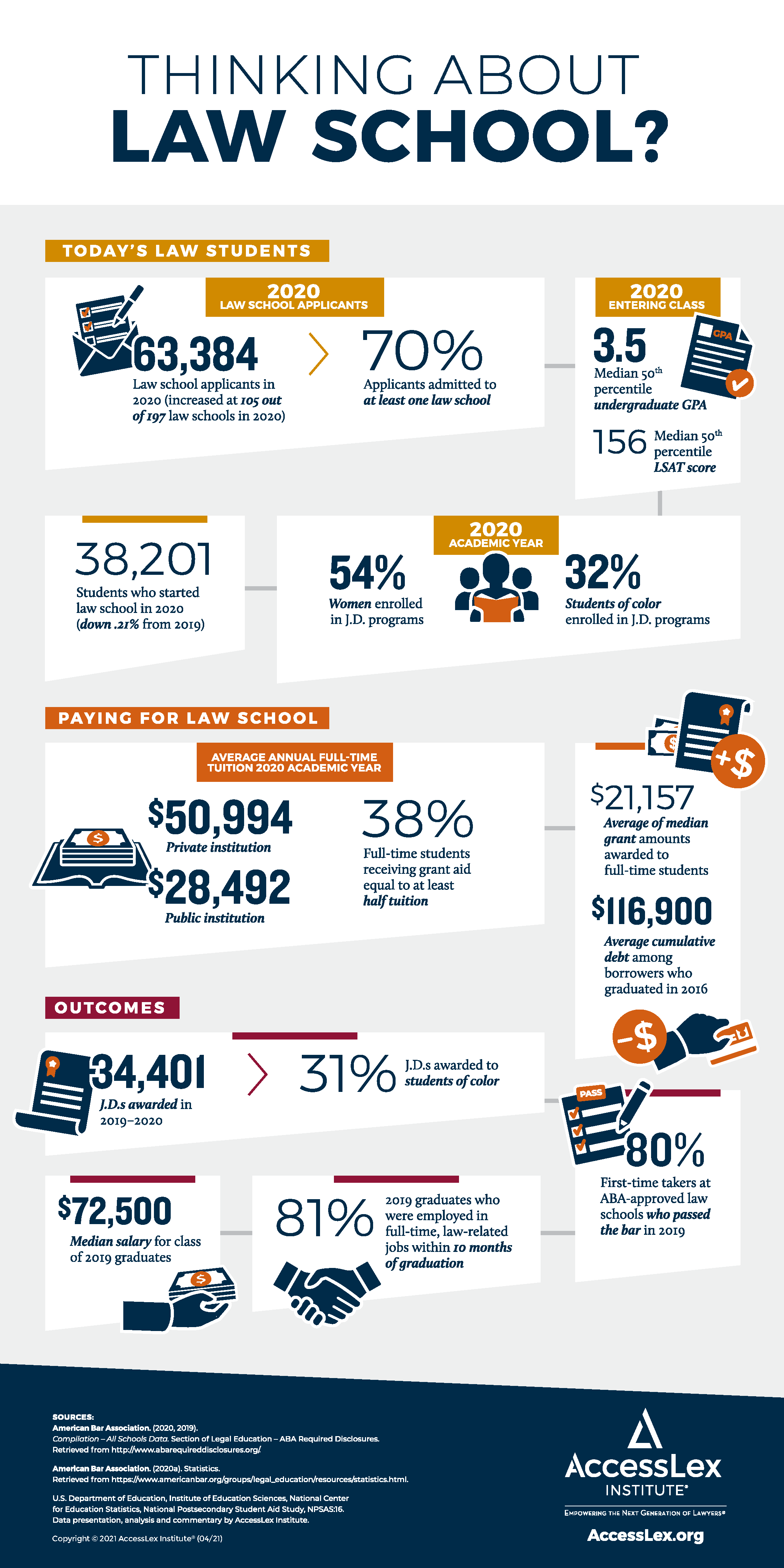
Attending law school is extremely expensive. Tuition at a private law school, plus living expenses and books, can run well over $60,000 per year. Only the wealthiest students can afford to pay this amount as they go through three years of law school. Most law students have to borrow substantial amounts to finance their law school education.
The average debt for graduating law students is on the order of $100,000; for students at many schools, it approaches $150,000. These figures do not include debt from undergraduate schools. Based on the normal repayment period of 10 years, and current interest rates, the debt service on such loans starts at about $1,100 per month, depending on the interest rate (and you’ll end up paying back about $140,000 for that $100,000 loan, once you add in the interest).
Law school tuition at a public university in the state where you reside will be substantially less than at a private school. Although there is not yet an ABA-accredited public law school in Massachusetts, the law schools at the University of Connecticut and the University of Maine offer reduced rates for residents of all New England states. If cost is an important criterion for you, consider a law school at a public university. It may be worth thousands of dollars to wait a year in order to establish residency.
Before deciding on how you’ll finance law school, however, you must first carefully consider whether law school is a good investment for you.
The nuts and bolts of law school financial aid
Each law school calculates its annual “cost of attendance,” or COA (sometimes referred to as the “student budget”). This figure includes tuition, fees, books, rent, food and health insurance. It does not include credit card debt or car payments. You will be eligible to borrow up to the amount designated as the COA. In calculating the COA and the amount you are eligible to borrow, law schools assume that you will not work while you are in school. (See below for a discussion of working during law school.)
When you accept an offer from a specific law school, you will work closely with its financial aid office to plan the financing of your education. They will guide you through the various programs and their requirements. Law school financial aid offices serve a much smaller population and tend to be more “user friendly” than what you may be used to. Never hesitate to contact them with your questions and concerns.
Terms, rates and lending programs have changed frequently over the last few years—enough that students are advised to seek out guidance from professionals who make it their business to keep up on graduate and professional financial aid. In particular, the following sites are reliable sources of information:
Law School Admissions Council (LSAC) - Good, detailed overview of the law school financial aid process.
Equal Justice Works - The experts on student debt relief for those considering careers in public interest or public service.
FinAid - Great resource about all things related to financial aid, for both undergraduate and graduate/professional school.
Institutional Aid
Scholarships and grants are a key method law schools use to compete with each other for top students. Law schools offer scholarships and grants to students based on defined criteria such as academic achievement, race, ethnicity, gender, or residency. As a general rule, law schools use their limited scholarship funds to attract students they don’t have enough of—e.g., high LSAT scorers at some schools, people of color at other schools, etc.
Most applicants don’t realize that law schools also compete with one another over students. If School A offers you a substantial scholarship, but it’s School B that you want to attend, don’t hesitate to ask the latter what they can do to match School A’s offer. The worst that can happen is that School B will not be able or willing to match the scholarship. But in many cases, they can and do make a competing offer to attract the applicant.
It’s vital to understand that not only are scholarships very competitive to obtain in the first place, they can be difficult to maintain once you enroll in schools. Scholarship offers almost always have strings attached: the student must maintain a particular grade point average or ranking in the class. For many applicants, these requirements seem relatively easy to meet, based on their undergraduate performance. But law school grades are different from undergraduate grades. In addition to the fact that in most first year law school classes, grades are based on a single exam at the end of the year, in many law schools, a strict grading curve is imposed. For example, the school may limit the percentage of any given class that can earn above a 3.5. If you scholarship requires you to maintain a GPA above that, it can be very difficult to do so. Similarly, a scholarship that requires you to finish your first year in the top 10% of your class is not nearly as easy as it first seems.
If you are offered a scholarship, before you accept, you should make sure you understand (1) what the specific conditions are, (2) what percentage of students each year meets those conditions, and (3) what percentage of first year students are able to maintain their scholarship the second and third years.
If you are considering a career in public interest law, you should also look into whether the schools you are applying to have a Loan Repayment Assistance Plan/Program (LRAP). These programs help lawyers make payments on their qualifying loans if they are working in the public sector (e.g., legal services or legal aid, some government work, other law-related non-profits). In addition, under two new federal programs, certain lawyers working in the public interest or government may be eligible for loan repayment assistance, loan consolidation, and/or loan forgiveness. Equal Justice Works maintains a comprehensive website of information about law school LRAPs and debt relief for public interest and public service attorneys.
Working during law school
During your first year of law school, you can expect to log 12-15 hours per week in the classroom. The most often-cited benchmark for outside study time is 2-3 hours of study for every hour of class time. Please note that that figure is an average—some students will study more and some lucky (or brave) few will study less. That means straight schoolwork will take up, on average, 45-60 hours of your week.
Now compare that time to what you are doing currently, either combining school and work as an undergraduate, or working full-time as a graduate. If it seems like a lot to you, then you probably will not want to work your first year of law school. If it seems like very little, then you may want to explore employment options.
Consider the following as your think about whether working during law school is a realistic part of your financial planning:
- law school entails a different kind of studying for most people, and it will likely take you longer to prepare for class than you are accustomed to;
- many schools place restrictions on student employment during the first year;
- all schools, as mandated by the ABA, restrict full-time second and third year students to no more than 20 hours a week of employment during the school year (enforcement of this rule varies considerably, however);
- depending on where you go to school, the opportunities for paid employment will vary widely;
- in upper years, you will have other demands on your time besides classes, including moot court, law journals and other student activities.
Don’t forget your summers. Most students try to obtain paid legal employment during the summer. How easy that is depends in large part on where you go to law school, and what the local market for law student associates is. This can be a highly remunerative source of employment if you are in a big law firm in a medium or large city. Summer legal employment may be much less financially rewarding (but beneficial in other ways) if you work in a public interest firm or for a small law firm. Summer employment is not just a way to make ends meet and potentially diminish the next year’s tuition bill. It is also an investment in your future career in terms of professional networking and the exposure to actual law practice. Make sure you talk to your law school’s career services center about summer employment during your first semester at school.